More from Tallis against the mania for neural reductionism

Here is a review by Raymond Tallis of two recent books arguing for more sophisticated discussions about the mysteries of consciousness – i.e., discussions amounting to more than, “Hey, when I show the subject Rothko paintings, *that* part of the brain lights up!”. Representative quote from the review:

A brain in good working order is, of course, a necessary condition of every aspect of human consciousness, from basic perception to the most complex constructed sense of self. It does not follow that this is the whole story of our nature—that we are just brains in some kind of working order. Many aspects of everyday human consciousness elude neural reduction. For we belong to a boundless, infinitely elaborated community of minds that has been forged out of a trillion cognitive handshakes over hundreds of thousands of years. This community is the theater of our daily existence. It separates life in the jungle from life in the office, and because it is a community of minds, it cannot be inspected by looking at the activity of the solitary brain.

Student achievements: SLCC conference, Ethics Bowl

This past Friday and Saturday, a number of our students went above and beyond the call of undergraduate toil. On Friday, Mathias Fuelling and Carson Bessinger presented papers at an undergraduate philosophy conference hosted by Salt Lake Community College. The conference focused on Nietzsche’s philosophy, and Fuelling offered his own interpretation of the übermensch while Bessinger forged conceptual linkages among Nietsche, Thrasymachus, and Callicles (characters in Plato’s dialogues). Huenemann offered a keynote address which drifted myopically among Nietzsche, biological evolution, and cultural progress. Anyone interested in presenting at a conference should check our link over on the right of this page, and keep in mind that UVU will be hosting another such conference in spring 2012.

On Saturday, several of our undergraduates (I won’t list them, out of fear of leaving someone out), along with Drs. Kleiner and Holberg, traveled to Weber State and competed in the Ethics Bowl. Our team won 2 and lost 3 matches, so we didn’t make it to the nationals, but I am told we argued with brave fervor. It is truly exemplary for these students to have dedicated themselves to the task of preparing for this event and engaging in it. We are learning more each year, and will prepare to go again next November.

So to all: congratulations, and good on you!

God’s blog – comments on the creation?

UPDATE: Pretty pleased with what I’ve come up with in just six days. Going to take tomorrow off. Feel free to check out what I’ve done so far. Suggestions and criticism (constructive, please!) more than welcome. God out.

COMMENTS:

Disagree with the haters out there who have a problem with man having dominion over the fish of the sea, the fowl of the air, the cattle of the earth, and so on. However, I do think it’s worth considering giving the fowl of the air dominion over the cattle of the earth, because it would be really funny to see, like, a wildebeest or whatever getting bossed around by a baby duck.

The whole piece here.

Dead salmon brain scans

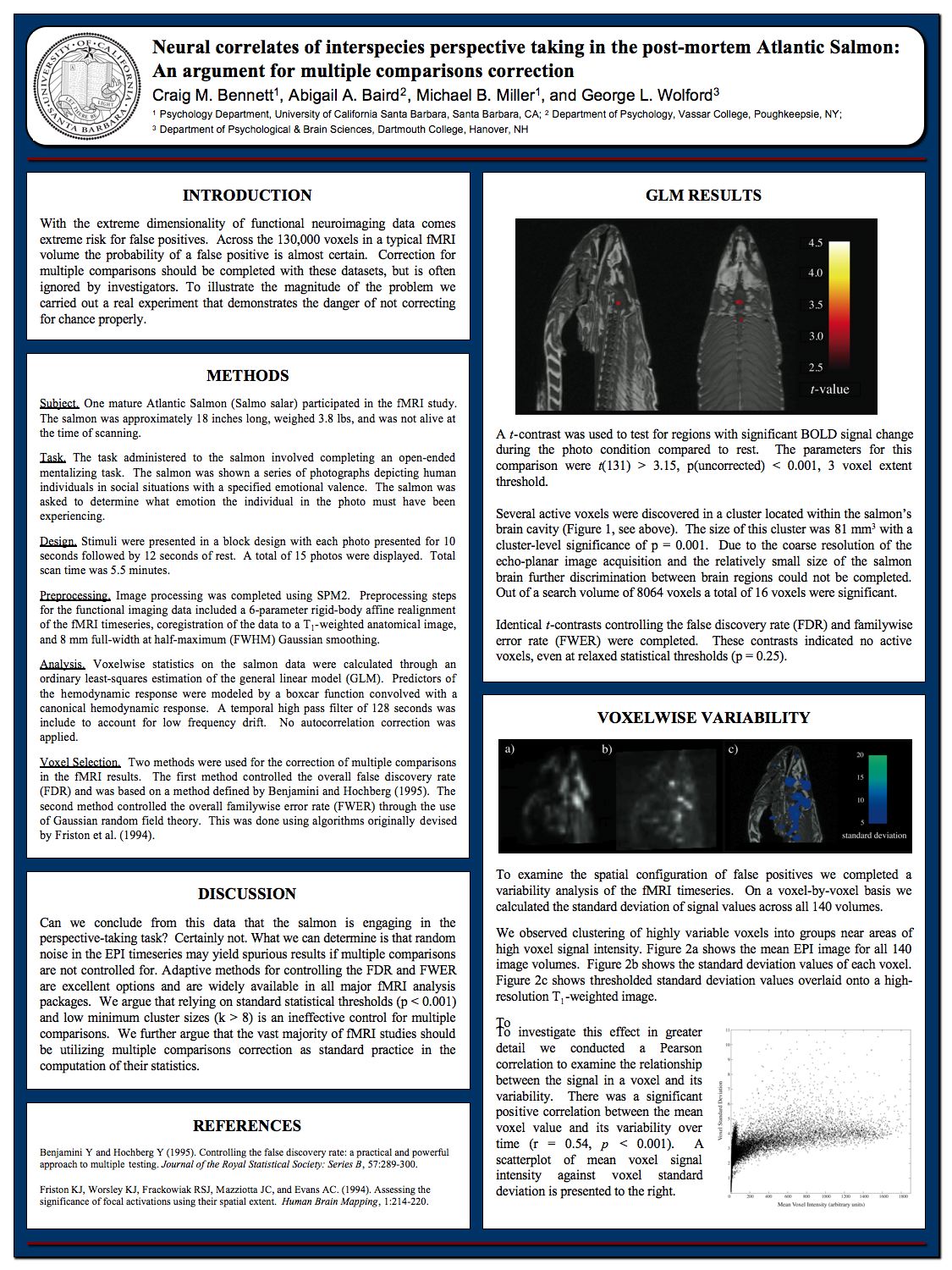
Four psychologists, in an effort to show that interpreting brain scan results requires careful correction for scanning errors, took a dead fish and showed it pictures of people in emotional states. “The salmon was asked to determine what emotion the individual in the photograph must have been experiencing.” Yes, parts of the brain “lit up”, but the researchers seem reluctant to conclude from this that dead fish engage in perspective-taking tasks. See the poster of their results here.

PS – Their title for their presentation is hilarious: “Neural correlates of interspecies perspective taking in the post-mortem Atlantic Salmon: An argument for multiple comparisons correction.” (And, by the way, “Dead Salmon Brain Scans” is an excellent name for a rock band.)

“Do we have a right to knowledge?”

The library is celebrating Open Access week, and is featuring a panel discussion on this question with ethicist Erica Holberg, physicist Charlie Torre, and USU Press Director Michael Spooner. Each will share his or her unique perspective on our right to knowledge and the impact open access has on his or her discipline. The discussion will be held in Library 101 at 4:30 on Wednesday, October 26th.