
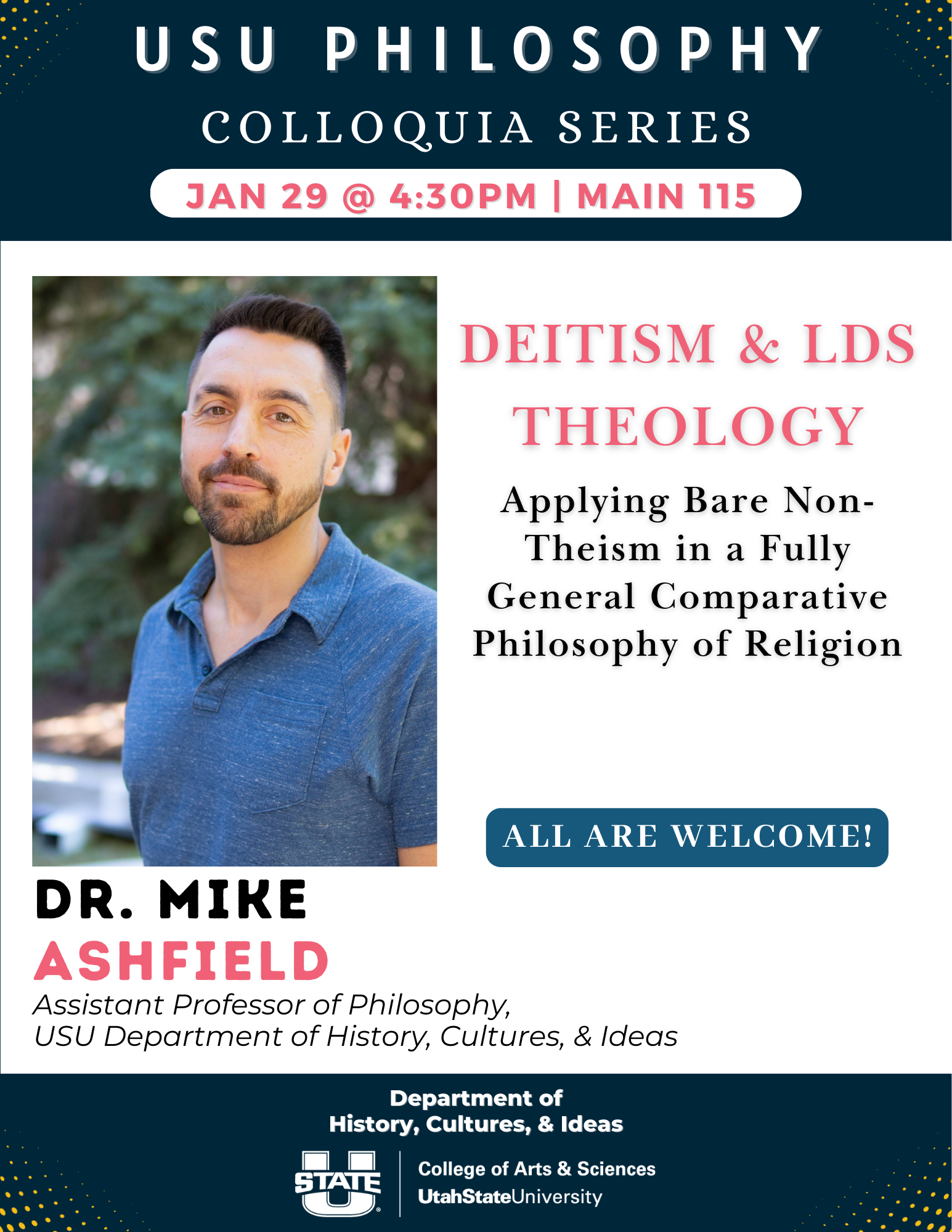
Abstract: What is a god? What is non-theistic or minor godhood? In this sequel to Dr. Ashfield’s December 2024 colloquium on bare theism and LDS theology, he will explicate ‘deitism’ to designate the commitment shared by all who countenance the existence of gods of limited rather than ultimate power, or local rather than global explanatory significance, but not those rejecting the existence of god(s) in favor of ultimate beings (i.e., God), other supernatural, holy, or transcendent entities (e.g., ghosts, holy texts, eternal vocables), nor those rejecting all of the above.
A successful explication of deitism’s commitments should (1) make them distinguishable from expressly non-deitistic positions (e.g., pure atheism, pure animism, pure theism, etc.), (2) identify something common to many paradigmatic deitistic positions, while minimizing dependence on philosophical parochialisms, and (3) not obscure (but ideally clarify) what’s at stake in debates about a given tradition’s (non)theism.
So, after considering alternative definitions of non-theistic godhood suggested by Michael Levine (1994), Vijay Ramnarace (2023), and Purushottama Bilimoria (2024), Ashfield will defend an explication of ‘deitism’ in terms of agential contingent transcendence, on which a non-theistic deity is an agential being that contingently transcends the natural order in some respect. After illustrating and defending the implications of agential contingent transcendence, including its implication for LDS theology, he will argue that it satisfies desiderata (1), (2), and (3) better than the alternatives.
Audience Q&A will follow. We hope to see you there!
 USUPhilosophy