
Author: Huenemann
Neuroscience and free will – another one!
Now here is an interesting article. I know, the very idea of brain implants ‘boosting’ free will sounds confused on various levels. But consider the phenomenon. Some subjects report the inner feeling of having lost free will – not being able to get up and do what they feel like doing. Various supplements are made available to help these people execute their desired actions. I think the right question to ask is, What is the conception of free will, such that subjects feel they don’t have it, and then they do? And does this have anything at all to do with the concept of causal determinism?
An interesting excerpt:
One depression patient participating in a 2008 University of Toronto study had responded well to DBS, but experienced a return of his symptoms after a battery in the pulse generator ran out. ‘I’m just happy it wasn’t me, that it was the battery,’ he remarked. This is a misunderstanding: it was not the malfunctioning pulse generator but faulty circuits in his brain that were causing his depression. Understandably, his comment reflected a desire to believe that he and not the device was in control of his mood and actions. Yet the fact is that DBS does not replace the person as the agent. Instead, it is an enabling device whose modulating effects on dysfunctional brain circuits return this control to him. It does not matter whether our mental states and actions are generated and sustained by a natural or an artificial system such as DBS, HP or BCI. Provided that these systems connect in the right way with neural inputs and outputs that regulate our minds and bodies, they can ensure that the person in whom they are implanted is in control.
Neuroscience and free will
I’m not sure what to think about this article. BUT WAIT! Before you clink on that link and read it, please take a second to complete the following poll:
Suppose scientists came up with a device that could read your brain activity and accurately predict every decision you make before you make it. Would you then conclude that you have no free will? Or is your belief in human liberty so strong that the very idea of such predictability seems to you impossible? Or do you see no conflict between free will and such predictability? Or would it matter only if someone informed you about the predictions?
UPDATE: I can’t get the poll to appear, so give the matter some thought, and then read the article and see what you think!
A defense of virtue ethics
A recent post on Scientia Salon by Peter D. O. Smith defends virtue ethics as a way to work through many of our contemporary moral stumbling blocks. An excerpt:
In short, virtue ethics is capable of supplying an intrinsic motivation that is acceptable to both the secular and religious worlds. We live in an overwhelmingly rules dominated world. Virtue ethics offers a way of internalizing and then integrating rules such that they become intrinsically motivating. It is a promising field for finding common ground between the secular and religious worlds, to makes rules and regulations more effective, and to provide a source of meaning for the non-religious.
The rest of the essay is here. It’s well-informed, and written with intelligence and clarity.
Schopenhauer, not Scrooge: a defense
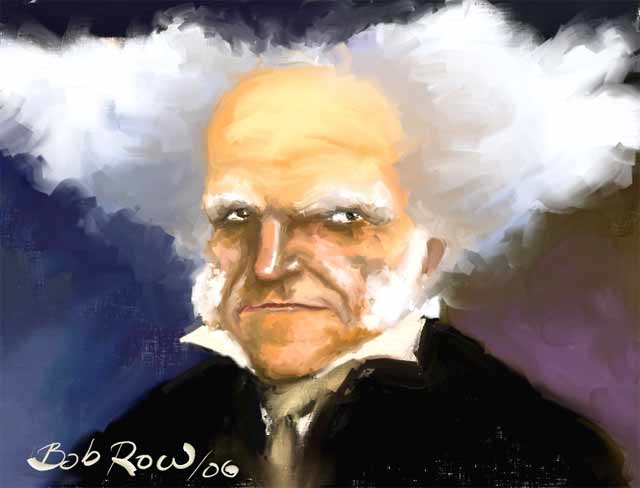
by Alex Tarbet
Since students are invited to post on the blog (and I hope I’m not the only one who does!) I thought I’d put together a piece on Schopenhauer. He plays a crucial role in the texts we’re reading in Dr. Huenemann’s seminar (Spinoza, Emerson, Nietzsche) and his moral aesthetic has got to be one of the most enjoyable and profound pieces of philosophical writing there is – something I’ve heard from other majors too. Emerson’s views on education (American Scholar) and early Nietzsche (Birth of Tragedy) reek of inspiration.
[Gutenberg link] http://www.gutenberg.org/files/38427/38427-h/38427-h.html#toc17
First, Schopenhauer often goes unread, labeled the “Great Pessimist,” and left on the shelf because nobody in their right mind wants to go there. But he goads us into reading on:
…My last refuge is now to remind [the potential reader] that he knows how to make use of a book in several ways, without exactly reading it. It may fill a gap in his library as well as many another, where, neatly bound, it will certainly look well. Or he can lay it on the toilet-table or the tea-table of some learned lady friend. Or, finally, what certainly is best of all, and I specially advise it, he can review it.
He deserves a defense. Wrong are those who brush him off as a “Scrooge” character who profoundly stubbed his toe one day and will never let it go. Rather, he is decisively not a pessimist, beyond his infamous metaphysical claim about the Universe. He offers a profound, surprisingly fresh and breathtaking aesthetic as the philosophical purpose of life.
Though himself an atheist, Schopenhauer impressively justified that human existence ought to be lived with peace, compassion, intellectual wonder and artistic contemplation as its highest goods. So what sounds at face-value like a depressing and miserable philosophy is in fact alluring to those with a religious spirit and a concern about tranquility, beauty and the sufferings of other beings. The ideal man for Schopenhauer is indeed Jesus Christ.
In an age when ancient Eastern religious manuscripts began to be translated and distributed in Europe, Schopenhauer combined Plato, Kant and the Hindu Vedas in a profoundly clever and straightforward way. His system aligns and befriends Christianity and Buddhism with a central interest in alleviating human suffering, while providing a metaphysical explanation by means of rational reflection. This is a high bar to jump, but like any great philosopher, he does many things at once with style.
On the other hand, outside the great system itself, like any other great philosopher (or any of us), Schopenhauer has shortcomings. Kant was a racist; Heidegger a Nazi; Plato a censoring authoritarian; Aristotle argued for slavery. These petty criticisms of course ought to make us yawn under the shadows of their accomplishments. Schopenhauer’s views on women and love are especially scathing, but no reason to look down on his masterpiece.
With that aside, why does this matter in context of our class? Nietzsche and Emerson toy with claims of value. In order to make statements about the meaning and purpose of life, they (and we) must have some metaphysical explanation for why the Universe exists beforehand. (If anyone wants to argue philosophically against this, I’d love the conversation.)
 USUPhilosophy