2013 Phi Sigma Tau induction

Six new members were inducted into the Utah Gamma chapter of Phi Sigma Tau, the national honor society of undergraduate philosophy. Congratulations and welcome to Emily Cannon, Evan Cummings, Ben Harman, Cameron Hunter, Erika Lamborn, and Jess Van Natter.

The august presidding officers lead the ancient ceremony
The august presiding officers lead the ancient ceremony
Inductees affirm their allegiance to philosophical principles
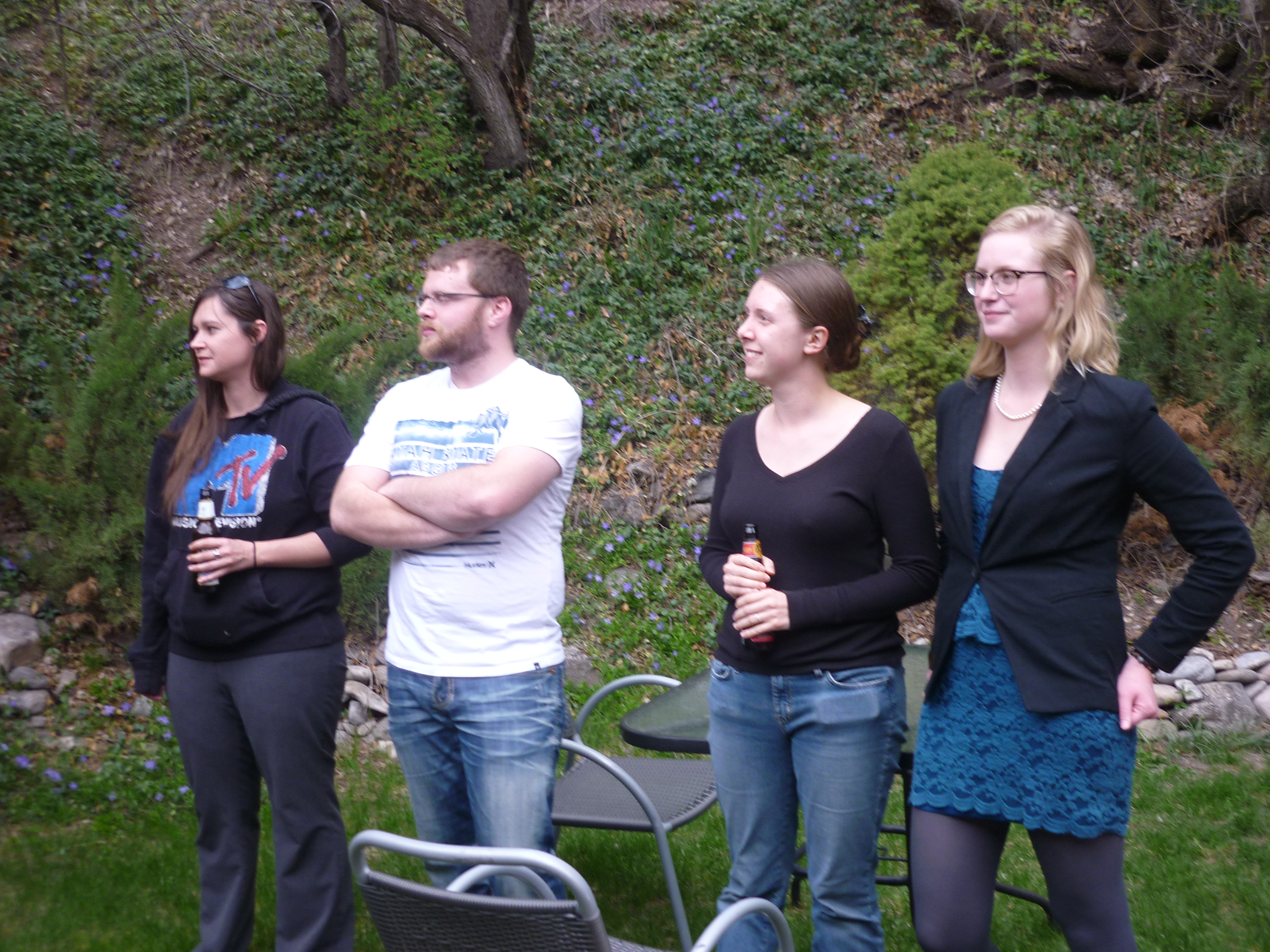
Convivial dialogue
Convivial dialogue
More convivial dialogue
Fez-wearing party-crasher

What do philosophers believe?

(H/T Rob Sica.) The organizers of Philpapers conducted a fairly extensive survey to determine what most professional philosophers believe about a range of issues. See their results and methods here. Some interesting results:

1. A priori knowledge: yes 71.1%; no 18.4%; other 10.5%.

2. Abstract objects: Platonism 39.3%; nominalism 37.7%; other 23.0%.

3. Aesthetic value: objective 41.0%; subjective 34.5%; other 24.5%.

4. Analytic-synthetic distinction: yes 64.9%; no 27.1%; other 8.1%.

5. Epistemic justification: externalism 42.7%; internalism 26.4%; other 30.8%.

6. External world: non-skeptical realism 81.6%; skepticism 4.8%; idealism 4.3%; other 9.2%.

7. Free will: compatibilism 59.1%; libertarianism 13.7%; no free will 12.2%; other 14.9%.

8. God: atheism 72.8%; theism 14.6%; other 12.6%.

[…]

28. Trolley problem: switch 68.2%; don’t switch 7.6%; other 24.2%.

29. Truth: correspondence 50.8%; deflationary 24.8%; epistemic 6.9%; other 17.5%.

30. Zombies: conceivable but not metaphysically possible 35.6%; metaphysically possible 23.3%; inconceivable 16.0%; other 25.1%

LPCS Symposium

Congratulations and thanks to all the philosophers who presented at the LPCS Symposium: Tate, Solum, Hunter, Hobbs, Tarbet, Harvey, and Harman. I was at first chagrined to discover each presenter would have only 10 minutes, but as we got underway, I found that “lightning philosophy” is fun. And congratulations to Tate on winning the overall “Best Paper” award for the symposium!

LPCS Colloquium this Friday

The Philosophy session runs from 5:15 to 6:30, in Main 117. Given the number of papers and the time constraints, it looks like we’ll have to limit each speaker to a total of 10 minutes for presentation and questions. This is speed philosophy!

SESSION 17, ROOM 117: PHILOSOPHY
Moderator: Dr. Charlie Huenemann
 
Dan Tate, “The Indispensable Apollodorus”
 
Justin Solum, “A Conversation on ‘The Cool'”
 
Alex Tarbet, “Ancient Winds: The Sophistry of Aristophanes”
 
Cameron Hunter, “The Art of Cosmology”
 
Richard Harvey, “Responding to Berkelian Immaterialism: Defending Internalist Scepticism and Physics”
 
Jaren Hobbs, “A Case for Naturalism from Reason”
 
Ben Harman, “Breaking the Spell: Morality as Natural Phenomenon”

Yet another practical employment of philosophy ….

… this time it’s consultants using Heidegger to bamboozle clients:

The founding story of ReD sounds more like the genesis of a doctoral dissertation than of a multimillion-dollar company. Madsbjerg says he became enamored first with post-structural theory, and then with the 20th-century German philosopher Martin Heidegger, who argued that the distinction between objects and their beholders needed to be effaced. When we consider a hammer, we might naturally think of its objective scientific properties: a certain weight and balance, a hardness, a handle with a rubber grip that has a particular coefficient of friction. What Heidegger posited is that these objective attributes are in fact secondary to the hammer’s subjective relationship with the person wielding it. The hammer has uses (a weapon, a tool), meanings (a symbol on the Soviet flag), and other characteristics that do not exist independently of the meeting of subject and object. A common mistake of philosophers, he claimed, is to think of the object as distinct from the subject. If all of this sounds opaque, I can assure you that in the original German it is much, much worse.But before long, Madsbjerg had a list of clients desperate for Heideggerian readings of their businesses. The service he provides sounds even more improbable to a scholar who knows his Heidegger than to a layperson who does not. Many philosophers spend their lives trying and failing to understand what Heidegger was talking about. To interest a typical ReD client—usually a corporate vice president who is, Madsbjerg says, “the least laid-back person you can imagine, with every minute of their day divided into 15-minute blocks”—in the philosopher’s turgid, impenetrable post-structural theory is as unlikely a pitch as could be imagined.

But before long, Madsbjerg had a list of clients desperate for Heideggerian readings of their businesses. The service he provides sounds even more improbable to a scholar who knows his Heidegger than to a layperson who does not. Many philosophers spend their lives trying and failing to understand what Heidegger was talking about. To interest a typical ReD client—usually a corporate vice president who is, Madsbjerg says, “the least laid-back person you can imagine, with every minute of their day divided into 15-minute blocks”—in the philosopher’s turgid, impenetrable post-structural theory is as unlikely a pitch as could be imagined.

But it’s the pitch Madsbjerg has been making. The fundamental blindness in the sorts of consulting that dominate the market, he says, is that they are Cartesian in their outlook: they view objects as the sum of their performance and physical properties. “If you are selling personal computers, you look at the machine and say it’s this many gigahertz, this many pixels,” he says. And you then determine whether a potential new market needs computers that perform faster than the ones currently on offer, and how big that market will be.