
For those of you who get into the rapid/fire and flaming delivery of reddit dialogues, there’s been a lot of action over this question:
Being in the World
Being in the World, a documentary film on the philosophy of Martin Heidegger
and its relevance to contemporary life will be screening at UVU on Thursday,
September 16 at 2:30 pm (Library Auditorium, LI 120), and at BYU on Friday,
September 17th at 6 pm (Harold B. Lee Library Auditorium). Both screenings
will be followed by a question and answer session with the film’s director
Tao Ruspoli, and Mark Wrathall one of the philosophers featured in the film
(University of California, Riverside).
Being in the World is a celebration of human beings and our ability, through
the mastery of physical, intellectual and creative skills, to find meaning
in the world around us. Some of our most renowned philosophers, from Harvard
to Berkeley, take us on a gripping journey to meet modern day masters-people
who not only have learned to respond in a sensitive way to the requirements
of their craft, but have also gathered their communities in ways that our
technological age threatens to make obsolete.
The film won “Best Documentary” at the Vail Film Festival, and an audience
award at the Brooklyn film festival. It will be appearing at other film
festivals around the world in the coming months.
Tao Ruspoli is an Italian-American filmmaker, photographer, and musician.
Moviemaker magazine singled out Ruspoli as one of the 10 Young Filmmakers To
Watch in its spring 2008 issue. His feature narrative debut, Fix, was one of
10 feature films to screen in competition at the 2008 Slamdance Film
Festival and soon afterward at the Santa Barbara International Film Festival
where Ruspoli was awarded the Heineken Red Star Award for “most innovative
and progressive filmmaker.” Fix also won the Festival Award for Best Film at
the 2008 Brooklyn Film Festival, Vail Film Festival and the 2008 Twin Rivers
Media Festival, as well as other prizes at several international festivals.
Mark Wrathall is Professor of Philosophy at the University of California,
Riverside. He is the author of Heidegger and Unconcealment: Truth,
Language, History (Cambridge University Press, 2010) and How to Read
Heidegger (Norton, 2006). He received a Ph.D. in philosophy at the
University of California Berkeley, and a J.D. from Harvard University. He
taught at BYU for 11 years before moving to his current position.
Mark Wrathall will also be speaking at BYU’s philosophy club at 11 am
Thursday morning (JFSB B032), and at UVU at 10 am Friday morning (in LI
120). The title of the BYU presentation is “Heidegger, Nietzsche, and the
Metaphysics of Truth.” The title of the UVU presentation is “An Education
in Thinking: Heidegger on Learning to Resist Technology.”
For more information on the film, visit the website at:
http://www.beingintheworldmovie.com
Avicenna
Students in religious studies, or intending to take Sherlock’s medieval philosophy next term, might be interested in this review of a recent book, Avicenna and his legacy: a golden age of science and philosophy.
The book’s primary emphasis is on the legacy of Avicenna (980-1037) undoubtedly because after Avicenna it is no longer the philosophical system of Aristotle that provided the source for philosophical speculation in the medieval East but the thought of Avicenna. (Here it might also be worth noting that Avicenna and His Legacy focuses exclusively on Avicenna’s heritage in the Islamic and Jewish medieval world and not his influence on European Christian thinkers.) Indeed, it is the philosophical legacy of Avicenna as it plays out in the post-classical Islamic east that unifies the near score of diverse essays that make up this book.
Hawking’s new book
is reviewed in the Economist here. It has always seemed to me that people are eager to have a physicist to idolize, like Einstein, and so have tried to idolize Hawking. But the popular writings of his that I’ve read strike me as unimaginative and clumsy, and the paeans sung to his genius are a little strained. His latest book sounds like more of the same. Here’s an amusing observation by the reviewer:
The authors rather fancy themselves as philosophers, though they would presumably balk at the description, since they confidently assert on their first page that “philosophy is dead.” It is, allegedly, now the exclusive right of scientists to answer the three fundamental why-questions with which the authors purport to deal in their book. Why is there something rather than nothing? Why do we exist? And why this particular set of laws and not some other?
It is hard to evaluate their case against recent philosophy, because the only subsequent mention of it, after the announcement of its death, is, rather oddly, an approving reference to a philosopher’s analysis of the concept of a law of nature, which, they say, “is a more subtle question than one may at first think.” There are actually rather a lot of questions that are more subtle than the authors think. It soon becomes evident that Professor Hawking and Mr Mlodinow regard a philosophical problem as something you knock off over a quick cup of tea after you have run out of Sudoku puzzles.
The book also makes what has been taken to be an audacious claim, that physics has no room for God. I gather it’s been seen as a big deal because up until now Hawking has played to the crowds by dropping pious remarks on occasion. And now he’s decided to back the other populist horse, and join ranks with Hitchens & Co. One thing for sure: the great physicist is not so hot when it comes to anything outside of physics.
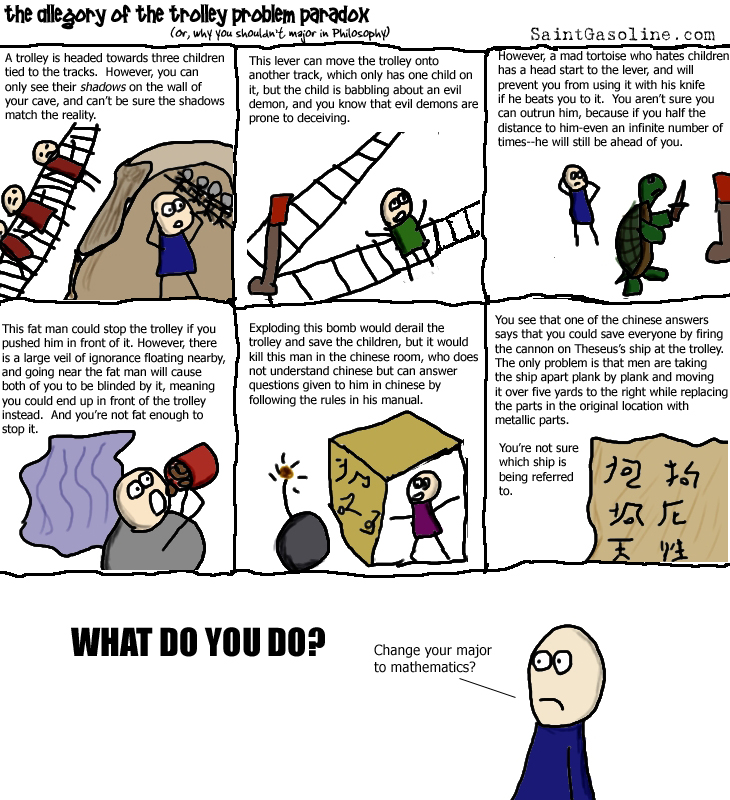
Should you major in philosophy?
 USUPhilosophy