

Author: Huenemann
Moral Foundations of Economics
From our colleagues in the business school —
We invite faculty and students to a seminar on leadership, trust, ethics, and markets.
Friday, September 28
3:00 p.m.
9th Floor, Business Building
The Department of Economics and Finance and the Institute of Political Economy have invited Professor David Rose, one of the preeminent scholars on the moral foundations of economic behavior, to visit the Huntsman School on September 28th and 29th. Dr. Rose is a Professor of Economics at University of Missouri and author of the recently published Oxford Press book titled the Moral Foundation of Economic Behavior. Professor Rose will be on campus to talk about how principles of trust promote a prosperous society.
Philosophy Club: Huenemann on philosophy & information
Philosophy Club Guardian Justin Solum bids me to advertize that I will be offering a short talk on the topic of philosophy and information this Wednesday, September 26th, at 5 p.m., in Main 227. This will be a presentation in preparation for a similar talk I plan to give later on, at the Intermountain Philosophy Conference. The abstract for that talk is as follows:
“It from Bit” – philosophical reflections
In this presentation I will reflect on a fascinating intersection of physics, information theory, and philosophy. Some physicists (beginning with Zuse 1967; more famously Wheeler 1990) have asserted that the ultimate substance in the universe is not matter, mind, or energy, but information: all of “it” is built from “bits.” Even earlier, the founder of modern-day information theory, Claude Shannon, employed the physical concept of entropy in order to sort information from noise in code strings. The proposed intersection of these fields is captured neatly in a provocative slogan: “Information theory is the thermodynamics of code strings, and thermodynamics is the information theory of particles in space” (Adriaans & van Benthem 2008). My presentation will not contain anything distinctively new or critical on the topic; this talk is more of an exploration for me, and so my aim is to be able to provide a competent and interesting overview of the topic, while pointing out possible philosophical consequences.
Anyone is welcome.
If Michael Sandel ruled the world …
… he would rewrite the economics textbooks. Excerpt:
If market values sometimes crowd out attitudes and values worth caring about (such as the love of learning for its own sake), then market reasoning must answer to moral reasoning. Standard economic models assume that markets are inert, that they do not touch or taint the goods they exchange. But if buying and selling certain goods changes their meaning, then the case for markets cannot rest on efficiency considerations alone. It must also rest on a moral argument about how to value the goods in question.
Read the rest here.
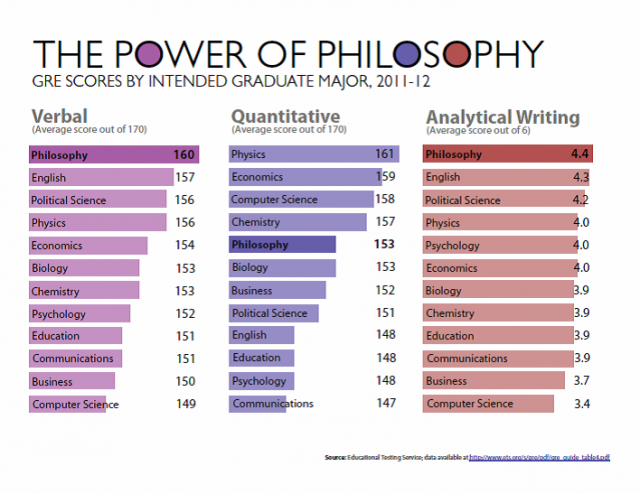
GRE scores
(Hat tip to pleasandexcuses.com)
 USUPhilosophy