
… on the topic of “Jewish-Christian relations after centuries of hostility” on November 20 (next Thursday) at 7 pm. Details on this flyer:
Category: Uncategorized
USU Ethics Bowl Team takes second!
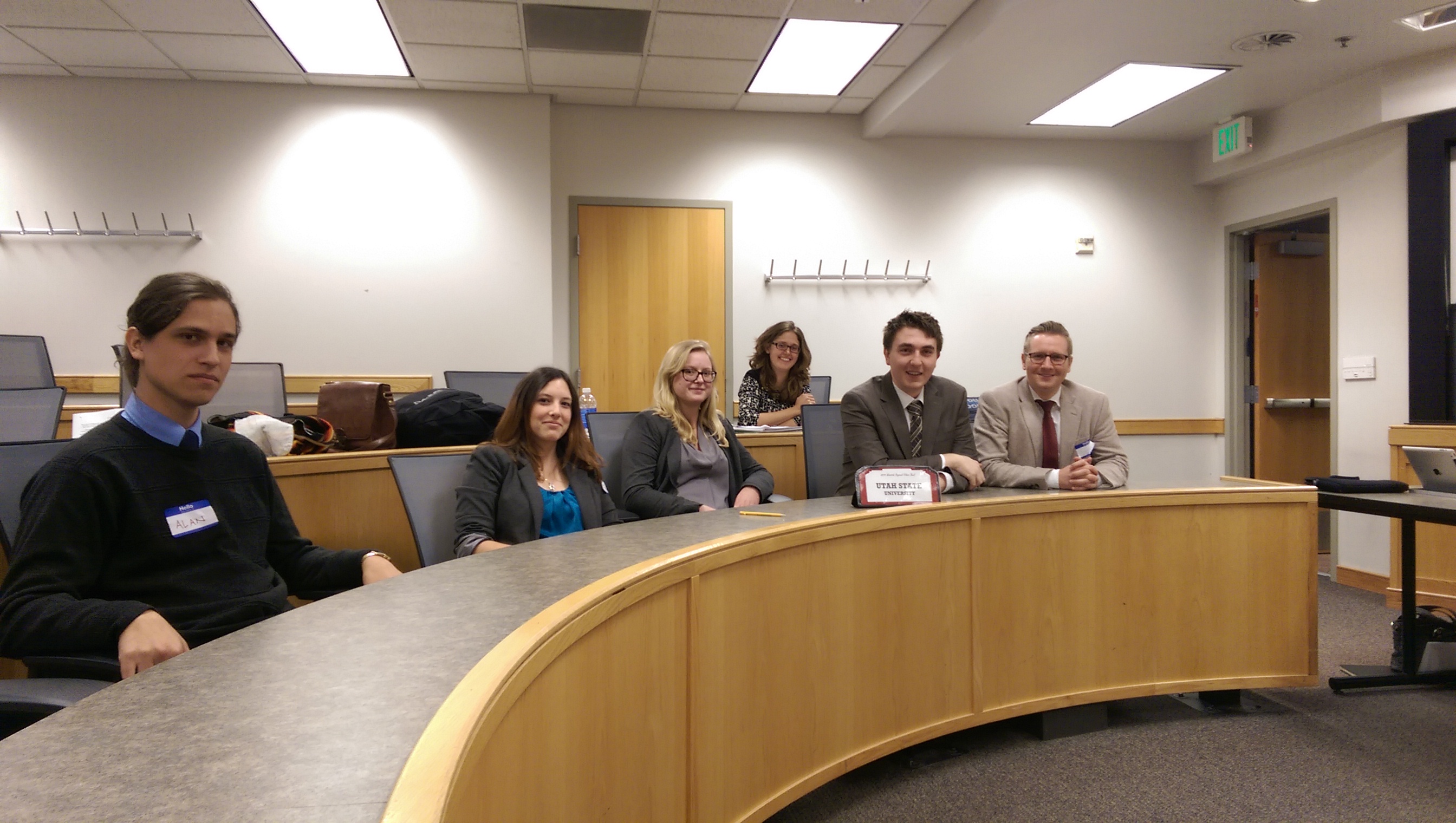
Congratulations to USU’s Ethics Bowl team: Andrew Izatt, Josh Smith, Alan Henderson, Prairie Fox, and Erika Lamborn, and to assistant coach Justin Solum and faculty leader Erica Holberg. The competition was fierce, and out team just narrowly missed first place. Well done, team!
Intermountain Philosophy Conference here Friday!
Professors from around the region will be here at USU this Friday afternoon to present and discuss their thoughts on various philosophical topics. All are welcome to attend any or all sessions. I’ll copy here a program of the events:
PROGRAM – Intermountain Philosophy Conference 2014(2)
12:15 – 1:00 – keynote address (Room 205):
“The Problem with Beginnings: Grasping at the Historical and
Psychological Origins of Patriarchy”
Professor Shannon Mussett, Utah Valley University
| Time | Room 201 | Room 205 | Room 207 |
| 1:00-1:30 | Thi Nguyen (UVU), “How to find a moral expert” | Nick Harrison (UU), “An Instrumentalist Application of Descartes’ Dualism” | Aaron Kenna (UU), “The Generality of Precision: Imprecise Probabilities, Ignorance and the Weight of Evidence” |
| 1:30-2:00 | Ryan Nelson (UU), “Imaginative Resistance as a Puzzle for Moral Realism” | Eric Stencil (UVU), “Descartes, Elizabeth and the Mind-Body Union” | Michael M. Shaw (UVU), “Nietzsche and Empedocles on the Permanence of Nature” |
| 2:00-2:30 | Erica Holberg (USU), “The Unenlightened Sex: Kant, Feminism, and Culpable Failures of Moral Imagination” | Kristopher G. Phillips (SUU), “Yet Another Paper on Descartes’s Argument for Mind-Body Dualism” | Richard Sherlock (USU), “Religious Studies and the Question of Truth” |
| 2:30-2:45 | BREAK | ||
| 2:45-3:15 | Russell Wahl (ISU), “Russell’s Neutral Monism” | Nobel Ang (ISU), “Spirited impetuosity or impetuous spiritedness?Aakrasia and related phenomena in Nicomachean Ethics Bk VII” | Anthony P. Smith (UU), “Breathing Life into Death: A Metabolic Definition of Death |
| 3:15-3:45 | Gordon B. Mower (BYU), “Hume’s Theory of Property” | Daniel W. Graham (BYU), “Socrates as a Deontologist” | Kara Barnette (Westminster), “Atoning for the Irrevocable” |
| 3:45-4:15 | Karen Mizell (UVU), “The Epistemology of Imagination and Play in the Community of Inquiry” | Harrison Kleiner (USU), “Myth, Moral Education, and the Liberal Arts” [Plato] | William McCurdy (ISU), “Charles Sanders Peirce is Not a Pragmatist:
Santiago’s Aristoteleanism“ |
| 4:15-4:45 | Anne Peterson (UU), “Aristotle’s Physics II.8: Coincidence, Empedocles, and Evolutionary Theory “ | Dan Molter (UU), “Defining the reference class: evolutionarily significant individuals in evolutionarily relevant situations” | Travis Anderson (BYU), “Frankfurt and Heidegger on the Things We Care About” |
Philosofoosball?
In case you’re interested –
You and your students are cordially invited to join us for our 2nd Annual USU Foosball Tournament!! BIGGER & BETTER than last year. We have two new, high-quality Tornado 3000 foosball tables (thanks to our sponsors Dean John Allen and James Morales). Please spread the word to your students:
Event: 2nd Annual USU Foosball Tournament
When? Tuesday, November 18th at 6:00 pm
Where? 3rd floor, Taggart Student Center
Registration fee: $3 per player (this includes free food and drinks sponsored by Buffalo Wild Wings). We are playing doubles but one can also sign up individually and pay at the door
Registration: claudia.schwabe@usu.edu or phone 435-881-4574
Everyone is welcome: Students, Staff, Faculty, etc.
Find us on FACEBOOK! (USU FOOSBALL CLUB)
Prizes for 1st place ($50 and trophy), 2nd place ($30 vouchers), and 3rd place ($20 vouchers)
Undergraduate journal opportunity
The national awarding-winning, international undergraduate philosophy journal Stance (stance.iweb.bsu.edu) is now taking submissions from exceptional undergraduates.
CALL FOR PAPERS
Stance seeks original philosophical papers authored by current undergraduates.
Submission Guidelines:
Stance welcomes papers concerning any philosophical topic. Current undergraduates may submit a paper between 1500 and 3500 words in length (footnotes may extend the word limit 500 words at most). Stance asks that each undergraduate only submit one paper for the journal per year. Papers should avoid unnecessary technicality and strive to be accessible to the widest possible audience without sacrificing clarity or rigor. They are evaluated on the following criteria: depth of inquiry, quality of research/academic rigor, creativity, lucidity, struggle, significance, and, most importantly, originality.
Submission Procedures:
Manuscripts should be in Microsoft Word (.doc) format and sent as an attachment to ballstatestance@gmail.com Manuscripts should be double-spaced (including quotations, excerpts, and footnotes) The right margin should not be justified
To facilitate our anonymous review process, submissions are to be prepared for anonymous review. Include a cover page with the author’s name, affiliation, title, and email address. Papers, including footnotes, should have no other identifying markers. Footnotes should follow Chicago Manual of Style. A style sheet with examples is available on our website under Papers We Seek. Please use American spellings and punctuation, except when directly quoting a source that has followed British style.
For further concerns, please visit Stance on the web at http://stance.iweb.bsu.edu/ or contact us at ballstatestance@gmail.com
DEADLINE: December 12, 2014
 USUPhilosophy