
The national awarding-winning, international undergraduate philosophy journal Stance (stance.iweb.bsu.edu) is now taking applications from exceptional undergraduates to serve as external reviewers. Please forward the Call for Reviewers, below, to your talented advanced undergraduates.
Schopenhauer, not Scrooge: a defense
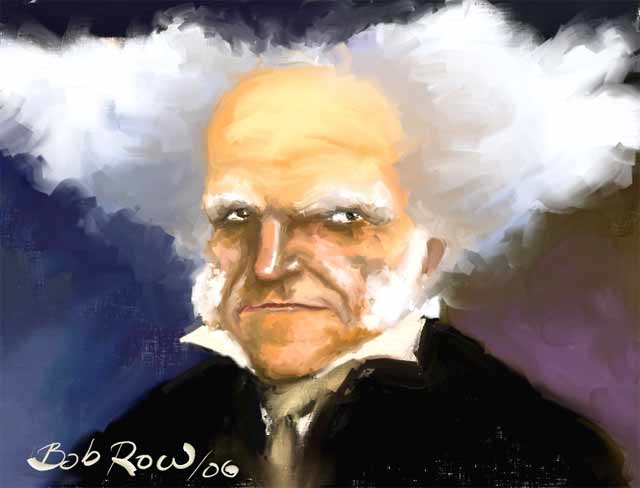
by Alex Tarbet
Since students are invited to post on the blog (and I hope I’m not the only one who does!) I thought I’d put together a piece on Schopenhauer. He plays a crucial role in the texts we’re reading in Dr. Huenemann’s seminar (Spinoza, Emerson, Nietzsche) and his moral aesthetic has got to be one of the most enjoyable and profound pieces of philosophical writing there is – something I’ve heard from other majors too. Emerson’s views on education (American Scholar) and early Nietzsche (Birth of Tragedy) reek of inspiration.
[Gutenberg link] http://www.gutenberg.org/files/38427/38427-h/38427-h.html#toc17
First, Schopenhauer often goes unread, labeled the “Great Pessimist,” and left on the shelf because nobody in their right mind wants to go there. But he goads us into reading on:
…My last refuge is now to remind [the potential reader] that he knows how to make use of a book in several ways, without exactly reading it. It may fill a gap in his library as well as many another, where, neatly bound, it will certainly look well. Or he can lay it on the toilet-table or the tea-table of some learned lady friend. Or, finally, what certainly is best of all, and I specially advise it, he can review it.
He deserves a defense. Wrong are those who brush him off as a “Scrooge” character who profoundly stubbed his toe one day and will never let it go. Rather, he is decisively not a pessimist, beyond his infamous metaphysical claim about the Universe. He offers a profound, surprisingly fresh and breathtaking aesthetic as the philosophical purpose of life.
Though himself an atheist, Schopenhauer impressively justified that human existence ought to be lived with peace, compassion, intellectual wonder and artistic contemplation as its highest goods. So what sounds at face-value like a depressing and miserable philosophy is in fact alluring to those with a religious spirit and a concern about tranquility, beauty and the sufferings of other beings. The ideal man for Schopenhauer is indeed Jesus Christ.
In an age when ancient Eastern religious manuscripts began to be translated and distributed in Europe, Schopenhauer combined Plato, Kant and the Hindu Vedas in a profoundly clever and straightforward way. His system aligns and befriends Christianity and Buddhism with a central interest in alleviating human suffering, while providing a metaphysical explanation by means of rational reflection. This is a high bar to jump, but like any great philosopher, he does many things at once with style.
On the other hand, outside the great system itself, like any other great philosopher (or any of us), Schopenhauer has shortcomings. Kant was a racist; Heidegger a Nazi; Plato a censoring authoritarian; Aristotle argued for slavery. These petty criticisms of course ought to make us yawn under the shadows of their accomplishments. Schopenhauer’s views on women and love are especially scathing, but no reason to look down on his masterpiece.
With that aside, why does this matter in context of our class? Nietzsche and Emerson toy with claims of value. In order to make statements about the meaning and purpose of life, they (and we) must have some metaphysical explanation for why the Universe exists beforehand. (If anyone wants to argue philosophically against this, I’d love the conversation.)
The usefulness of philosophy
Prof Huenemann presented today on “What is philosophy and why is it useful”. He sought, wisely I think, to underplay the instrumental value of philosophy and instead to focus on its intrinsic value. But for other reasons I had been getting data on its instrumental value and I thought it would be worth sharing. Here is my philosophy “brag” (suitable for use with university administrators, state and federal legislators, and skeptical parents:
Philosophy students get the most portable job skill of all – they learn how to think (analytically and critically) and learn how to communicate. Very few disciplines are as effective in teaching these skills as is philosophy. For evidence we can look to a host of graduate entrance exam scores that test verbal reasoning, quantitative reasoning, and writing skills.
LSAT: From the set of majors that most commonly take the LSAT, philosophy majors have the highest scores. Of all majors that take the LSAT, philosophers score higher than every other discipline other than physics.
GMAC: On the most common test for MBA programs, philosophy majors score higher than every business major (scoring on average 10% better than the average of business majors). Overall, philosophy students are 5th highest among all disciplines, behind only physics, math, engineering, computer science.
GRE:
– GRE analytical writing: Philosophy has the highest scores of any major.
– GRE verbal reasoning: Philosophy has the highest scores of any major.
– GRE quantitative reasoning: Philosophy has the highest scores in the humanities, and score better than a number of non-humanities disciplines including agricultural science, natural resources, all education majors, and all social sciences except economics.
MCAT scores are not broken down by major officially by the AAMC but instead are broken down by broad major areas. Humanities students score second highest overall, behind only math and statistics and ahead of physical sciences, biological sciences, and social sciences.
First Ethics Bowl meeting tomorrow!
It’s not too late to join – Thursday, 12:00 – 1:15, Main 227!
“What is philosophy and why is it useful?” – Philosophy Club
Philosophy Club’s season will start off with a brief, informal lecture, by me (Huenemann), to be followed by discussion. Bring a lunch, and meet your philosophical colleagues! Wednesday, September17th, 11:30-12:30, Main 207. All are welcome.
 USUPhilosophy