Upcoming Phun Philosophy Events

TOMORROW (Saturday): Philosophy on Tap, White Owl, 7 p.m. (just look for the table of distracted, serious people). Fun discussion.

FLASH! Philosophy: submit a title of your 10-minute not-so-serious philosophical idea to present, like what makes idealism more hip than materialism, either to me (Huenemann) or to justin_solum {at} yahoo.com by this Tuesday (11/19). The event will be on Thursday (10/21), 5:30 p.m., place TBD.

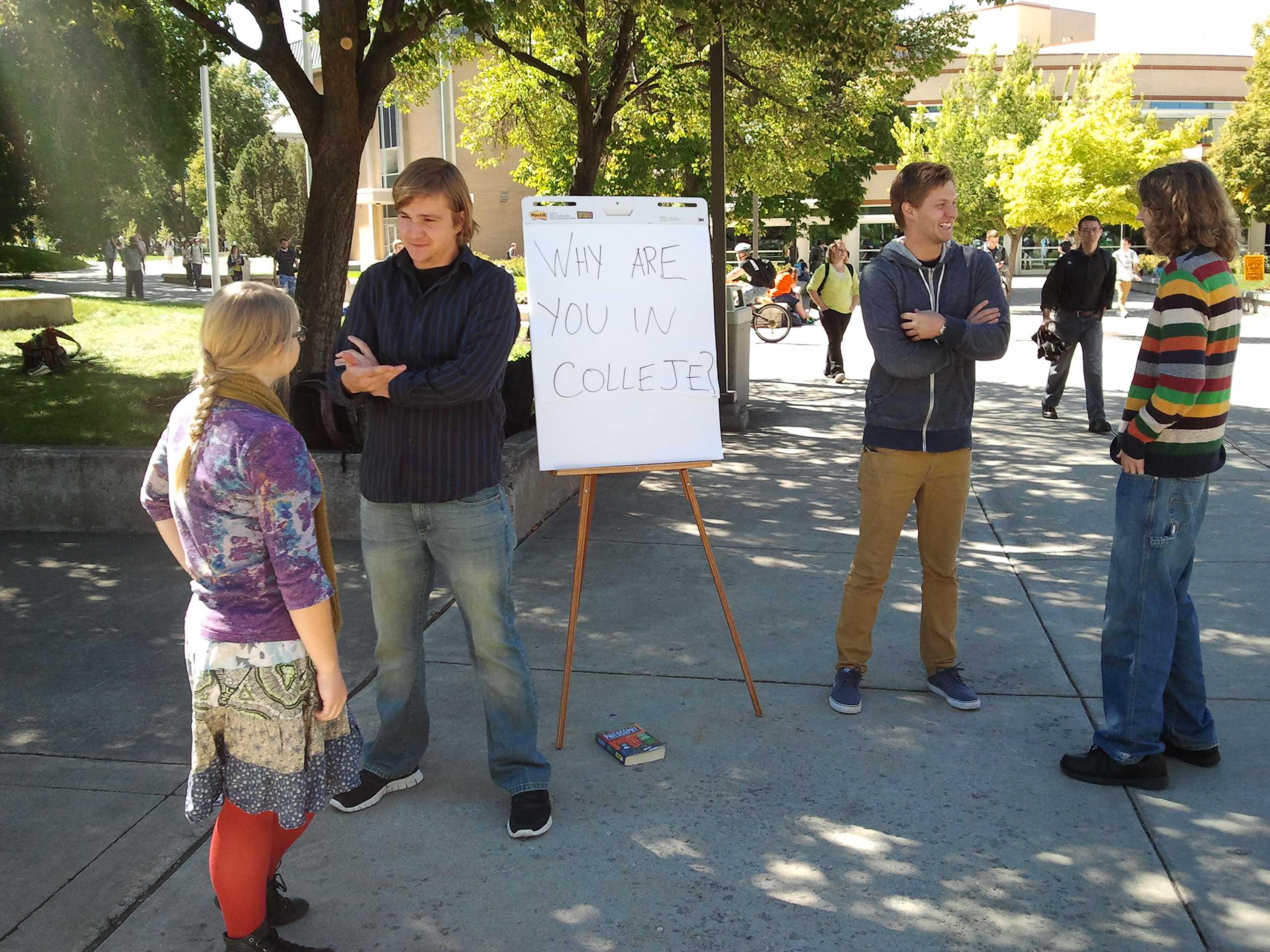
Finally, Solum tells me this: “Tarbet and I have been periodically going out into “free speech zone” on campus and attempting to engage in conversation with non-philosophy students by posing questions to them such as: What is art? Why are you in college? What does it mean to be “right”? etc. We want other philosophy students to feel free to come and join us if they ever see us there, but we want to make clear that the purpose of this is NOT for philosophy students to talk with each other, rather it is so we can bring philosophy down from its supposed “ivory tower” to other students and show that philosophy’s questions are important for everyone.” Good show, gents!

SAMSUNG

Philosophy lecture on Kierkegaard

We are happy to welcome back Brian Soderquist, USU philosophy alumnus and world expert on Soren Kierkegaard:

K. Brian Soderquist
University of Copenhagen
“Truth and Untruth in Kierkegaard’s Book on Adler”

Wednesday November 13
4:30
ESLC 053 (that’s the Chemistry building)

Alle er velkomne!

Announcement: PHIL special topics course for spring

I will be teaching a philosophy special topics course this spring (PHIL 4900 Special Topics: What is an Educated Person?), MWF 2:00-2:50.  This is a full course version of the CHASS reading group I have run the past few years.  The book order has just been submitted, so in  a day or two the course should show up on Banner for registration.

The class will investigate the purpose and value of liberal education.  Some questions to be considered: What is the end of liberal education?  How does liberal education differ from vocational education (job training)?  What is the place of books in education?  What underlying metaphysics of man, if any, is implied by liberal education?  Can a university be truly secular / metaphysically neutral, or must it make metaphysical commitments?  What challenges are facing the modern university, and what opportunities?

Texts / authors read: Gilgamesh, Plato, Aristotle, Newman, Hobbes, Descartes, Bacon, Dewey, Nussbaum, Lewis, and more!

No prerequisites required.  I expect that students will leave the class (a) having thought deeply about some interesting questions, (b) having developed a deeper understanding of the ends of education and (c) having developed the capacity to speak clearly and powerfully about the value of a liberal arts education.

Two announcements

1. There is a course, “Ethics and Biotechnology”, which offers Depth Science credit (DSC). It is offered under two course listings – PHIL 4530 and ADVS 3200. It is one and the same course, no matter what it is called. But if you are majoring in the humanities (majoring in Philosophy), and you seek to gain DSC credit for the course, you must sign up under ADVS 3200. If you goofed and took the course under the other listing, talk to me, and we’ll try to fix it.

2. I have many copies of the last two issues of Dialogue, the undergraduate journal of philosophy’s national honor society, Phi Sigma Tau. I will leave these copis in a box outside my office door (Main 208). Feel free to take a copy. They are good and interesting areticles by your undergraduate peers at other institutions.

Dressing up at Halloween

I received a note recently from the ASUSU (or USUSA?) VP for Organizations and Diversity asking advisors to remind students that (in my own words) some costume choices unwittingly betray cultural insularity. In other words, many of us tend to think of other cultures as so profoundly Other that we think of dressing up as Them in the same way we think of dressing up as vampires or zombies. Indeed, Hollywood, that great engine of American cultural production, encourages us to think that really silly cartoon characters should have foreign accents. Believe me, I’m the last person to be a spoilsport for Halloween, but there are times when one should think about the philosophical implications of selecting a costume. The posters below express this point more directly than the words I’m spilling now.

STARS Poster Campaign 2012